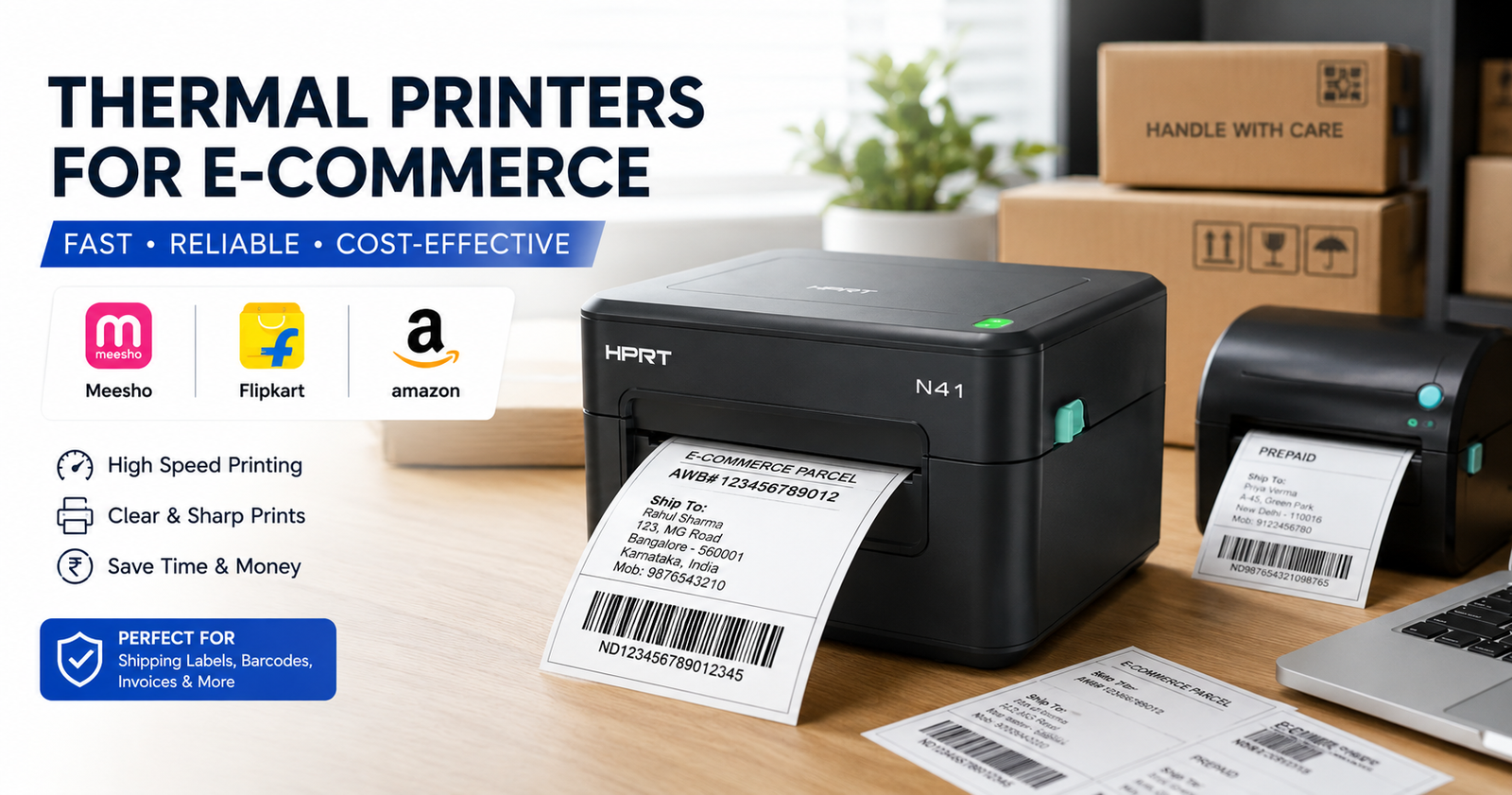
If you have just purchased your first thermal label printer for your Meesho, Flipkart, or Amazon business, congratulations — you are about to save thousands of rupees per month on ink and paper costs. However, setting up a thermal printer on Windows 10 or Windows 11 is not always as straightforward as plugging in a regular inkjet printer. This comprehensive guide walks you through the entire setup process from unboxing to your first perfect label print.
Step 1: Unboxing and Physical Setup
Most thermal printers (Xprinter, TSC, Zebra, TVS, HPRT) come with the following items in the box: the printer unit, a USB cable, a power adapter, a sample roll of thermal labels, and a quick start guide (which is usually in Chinese or poorly translated English). Here is what you need to do first:
- Place the printer on a stable surface near your computer. Keep it away from direct sunlight and moisture, as both can affect the thermal paper quality.
- Connect the power adapter and plug it into a wall outlet. Most thermal printers use 24V DC power — do not use a different adapter as it can damage the print head.
- Load the thermal label roll. Open the top cover of the printer. Place the label roll on the spool holder with the printable side (the slightly glossy or smooth side) facing up. Feed the paper through the guides and close the cover.
- Connect the USB cable to your computer. Windows should detect the printer and attempt to install a generic driver.
Step 2: Installing the Correct Driver
The generic Windows driver usually does not work well with thermal printers. You need to install the manufacturer-specific driver for your model. Here is where to find drivers for popular brands:
- Xprinter (XP-460B, XP-420B): Download from the official Xprinter website or search "Xprinter XP-460B driver download" on Google. The driver file is usually a .exe installer.
- TSC (TE244, TE200): Visit the TSC Auto ID website and navigate to Downloads → Drivers. Select your model and download the Windows driver package.
- Zebra (GK420d, ZD220): Zebra provides drivers through their Zebra Setup Utilities software, which auto-detects connected printers.
- TVS (LP 46 Neo): Available on the TVS Electronics website under Support → Downloads.
After downloading, run the installer and follow the on-screen instructions. When prompted, select the USB port where your printer is connected (usually USB001 or USB002).
Step 3: Configuring Paper Size
This is the most critical step and where most new users make mistakes. You need to configure the correct label dimensions in Windows. The paper size depends on which e-commerce platform you sell on:
- Meesho labels: 4 × 4 inches (100 × 100 mm) — landscape format
- Flipkart labels: 4 × 6 inches (100 × 150 mm) — portrait format
- Amazon labels: 4 × 6 inches (100 × 150 mm) — portrait format
To set this up in Windows:
- Go to Settings → Printers & Scanners (or Control Panel → Devices and Printers)
- Find your thermal printer, right-click it, and select Printing Preferences
- Go to the Page Setup or Paper Size tab
- If your label size is not listed, click "New" or "Custom" to create a custom paper size
- Enter the dimensions: Width = 100mm, Height = 100mm for Meesho (or 150mm for Flipkart/Amazon)
- Save and set this as the default paper size
Step 4: Calibrating the Printer
Calibration tells the printer where each label starts and ends on the roll. Without calibration, your prints may be offset, cut off, or skip labels. To calibrate:
- Turn off the printer
- Press and hold the FEED button on the printer
- Turn on the printer while still holding the FEED button
- Wait until the printer feeds several labels and prints a test pattern (usually small lines or blocks)
- Release the FEED button — the printer is now calibrated to your label size
If the calibration does not work with the button method, you may need to use the manufacturer's calibration utility software. Xprinter has a tool called "Bartender" that includes a calibration wizard.
Step 5: Printing Your First Label
Now you are ready to print. Open your cropped shipping label PDF (processed through EasyOrderLabel) and follow these settings:
- Select your thermal printer as the target printer
- Set the paper size to match your labels (4×4 or 4×6)
- Set scaling to "Fit to Paper" or "Fit to Printable Area" — never use "Actual Size"
- Set orientation to match your labels (Landscape for Meesho, Portrait for Flipkart)
- Print a single test page first before printing the entire batch
Common Troubleshooting Tips
- Labels are printing blank: The thermal paper is loaded upside down. Flip the roll so the smooth/glossy side faces the print head.
- Labels are misaligned or offset: Run the calibration procedure again (Step 4). Also check that your paper size settings exactly match your physical label dimensions.
- Prints are too light or faded: Increase the print darkness/density in the printer preferences (usually a slider from 1-15, try setting 8-10).
- Barcodes are not scanning: Increase the print resolution if possible, and ensure scaling is set to "Fit to Paper" not "Actual Size" which may crop the barcode.
- Printer is not detected by Windows: Try a different USB port. If using USB 3.0 (blue port), try a USB 2.0 port instead as some thermal printers have compatibility issues with USB 3.0.